FrontierCS 2: A Benchmark for Computer Science R&D
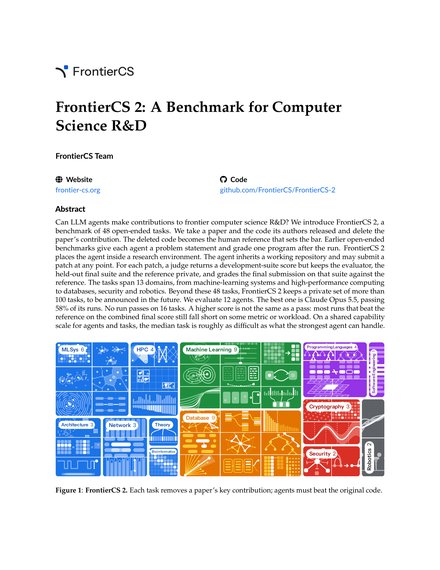
48 open-ended tasks, each built by deleting the key contribution of a computer science paper from its released code.
Papers from the FrontierCS team.
48 open-ended tasks, each built by deleting the key contribution of a computer science paper from its released code.
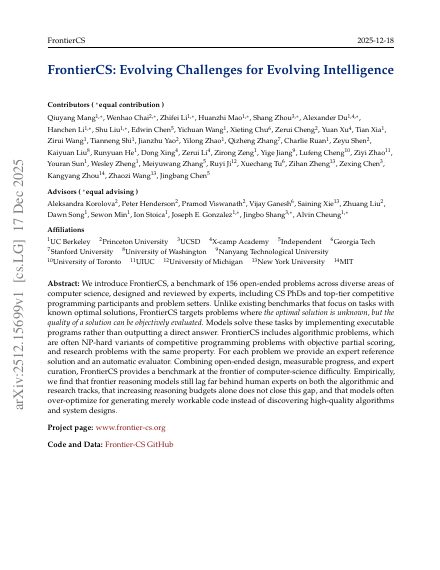
The benchmark paper: how the problems are built and scored, and how models compare with human experts.
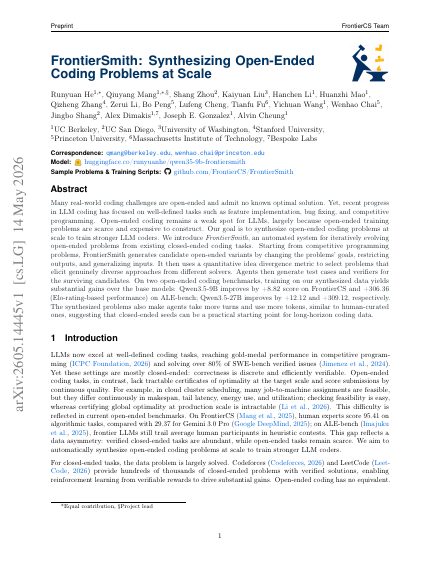
Turns closed-ended coding problems into open-ended ones for training, with results on FrontierCS and ALE-bench.
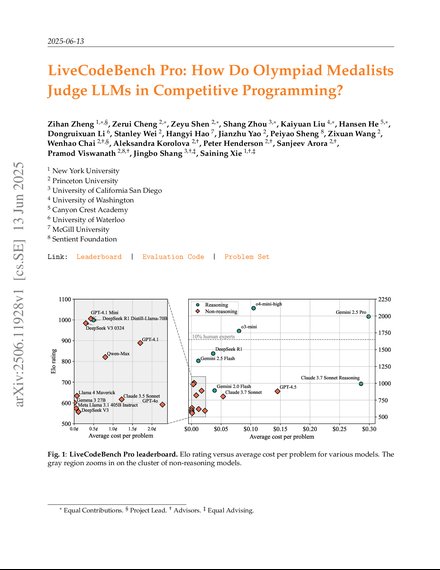
Competitive-programming problems from live contests, annotated by Olympiad medalists, to find where LLMs still fall short of experts.
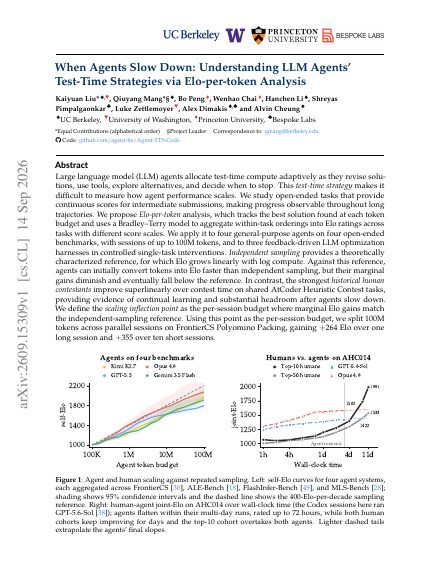
Follows the best solution as the token budget grows, and finds where an agent falls behind independent sampling.
A stable PPO for language models, trained with FrontierCS’s continuous score among its rewards.
Research that uses the FrontierCS benchmarks.
Connects agent inference, feedback, learning and versioned delivery. Its Guidance-TTT recipe runs FrontierCS Polyomino Packing with the FrontierCS judge.
Turns evolutionary search runs into training data; nearly half of its 371 tasks derive from FrontierCS. On held-out problems its 9B model averages 46.01, against 32.46 for the base model.
Trains a 27B agent on long trajectories in which it keeps improving its own solution. On 188 FrontierCS tasks it scores 70.7, 16.0 points above the strongest open-weight baseline.
Compares a team of agents that share findings with the best of as many independent agents. On Polyomino Packing the team reaches 0.945, above the best score reported before it.
Trains a small guidance model with reinforcement learning during the search; a frozen model writes the code. On Polyomino Packing it reaches 91.89, against 89.40 for CORAL and 89.10 for the human reference.
Periodically forks an agent’s run and clears its context so it leaves a plateau. Nine of its thirteen tasks come from FrontierCS; its normalized average is 0.78, against 0.47 for a single run.
Keeps the research state in the harness and builds a fresh context for every agent call. On a FrontierCS algorithm-design problem it scores 59.5 at 200M tokens, against 58.0 for the strongest baseline.
Periodically clears all agent sessions and the candidate history, and restarts a communicating team from its best candidate. On FrontierCS algorithmic problem 171 the team’s mean best score is 80.8, against 70.2 for four parallel agents at the same token cost.
Compares evolutionary search methods on the FrontierCS algorithmic problems with 50 GPT-5 calls each. AdaEvolve averages 61.33, against 50.75 for OpenEvolve and 20.64 for a single call.
Evolves the search strategy during a run as well as the solutions. On the FrontierCS algorithmic problems, with 100 iterations each, it reaches a mean of 62.6 and a median of 75.5.
Replaces fixed evolutionary rules with long-running agents that share memory. On Polyomino Packing, four agents reach 89.4% coverage, against 56.0% for a single attempt.
Splits a discovery system into generator, assessor, mechanism and budget, and tests each part in 760 runs on three FrontierCS problems. On Polyomino Packing, GPT-OSS-20B reaches a median of 45.0, against 21.5 for Claude Opus 4.6.
Distills GitHub repositories and papers into verified skills for a research agent. On 188 FrontierCS tasks the skills raise Codex from 70.63 to 77.14.
Composes search operators according to the state of the run. Averaged over 172 FrontierCS problems, its best of five runs scores 0.693, against 0.632 for the strongest baseline.
Reuses the history of earlier experiments to guide the search. On 49 FrontierCS algorithmic problems its mean best score is 6.13 points above the strongest baseline with DeepSeek V4 Flash.
Ports benchmarks to one agent-evaluation format and checks each port against the original. Its catalog has a verified adapter for the FrontierCS algorithmic problems, checked on 10 of the 172.