Agents do not budget their time or their submissions
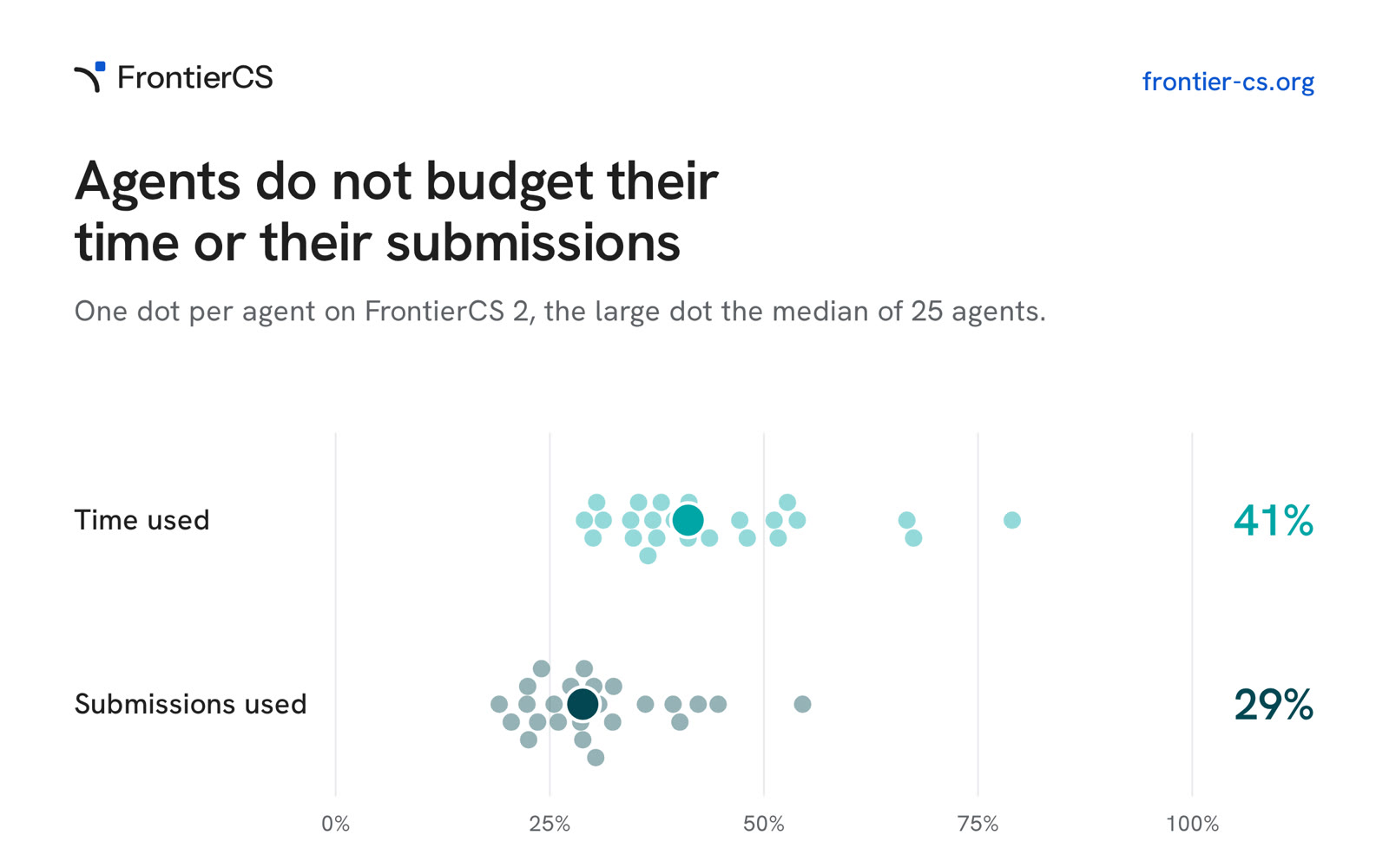
Across 1,200 FrontierCS 2 runs, the median agent used 41% of its time and 29% of its submission budget, and its use of submissions barely changes with the size of the budget.
Tag
7 posts tagged "FrontierCS 2".
Across 1,200 FrontierCS 2 runs, the median agent used 41% of its time and 29% of its submission budget, and its use of submissions barely changes with the size of the budget.
Claude Sonnet 5.5, Claude Fable 5.1, Inkling 2 Small and MiniMax-M3.1-Flash join the leaderboard. We show how far agents went to game the judge, how we closed each hole, and how we rebuilt all 48 tasks on one format and shared base images. Handshake and Snorkel AI join our sponsors.
Gemini 4 Carbon passes 26 of 48 tasks, as many as Gemini 4 Argon and second only to Claude Opus 5.5, and has a higher mean score than Argon where both submitted (57.7 against 52.9). We show how it tests more before its first submission, the three passes that used loopholes, and three runs that stopped early because the Antigravity harness stopped waiting.
Twelve models tried to beat the code that the SVG-EAR authors released for their ECCV 2026 sparse-attention method, and none passed. We show what each run tried, which of its 48 checks it missed, and by how much.
BBQ, an NSDI 2024 circuit, picks the next packet a network card sends. Gemini 4 Argon and Claude Opus 5.5 each gave it a faster clock than its authors did, one with the same memory and one with registers in its place. We build the circuit up from a 16-priority example to show both.
QuarterPIR, a EUROCRYPT 2024 scheme, lets a client read a database without revealing what it reads. Muse Wonder 1.0 cut its bytes per lookup by 27%, with privacy unchanged. We build the scheme up from a 16-entry example to show how.
FrontierCS 2 extends open-ended evaluation from static sandboxed tasks to Harbor-based feedback loops and repo-level environments.